Yesterday was one of those days for me. God has put this whole thing together one piece at a time as only He is capable of doing. As I stood at my farm, enjoying the view I just had to SMILE!

Farm Orchid
Does anyone know it's real name?
In 1998 after Hurricane Mitch, I met a wonderful missionary in Honduras named Linda H. We worked together during Mitch, not really together but apart doing similar things, helping each other and became good friends. Not the kind of friends which see each other every day of the week, but never the less, we became friends. I see her in passing at the airport maybe once a year and exchange emails several times a year and other than that just read what is going on with her on Facebook.

Talento, one of my horses

Another orchid from my farm, smells like vanilla...
Does anyone know what it is?
May 5th to be exact, Julie L. was visiting Honduras again and once again was at Janet R.'s house. So once again I made the trek out of town through winding Honduras mountain roads to visit. But this time there was an added coincidental meeting God had in mind. This time Jen W. was also there visiting. Jen W., it turns out lives in Tegucigalpa. She too is one of those people whom I gravitated to. She is "no nonsense, very merciful and a servant" in my humble opinion.

Now fast forward to last week. Alan and Julie L. were visiting Honduras yet again (I think they are called to live here, but maybe they aren't sure yet) and this time they invited me out to dinner with a bunch of other "gringos". I baked a cake and added a few other goodies from the freezer and off I went to visit. This time there must have been 15 or more gringos to meet and talk to. But I gravitated to Tim H. and we spent a while talking about hospitals, supplies, medical teams, etc. Then I found Nate, Andy H. and Zach S. I liked them because they are young and full of energy. A fresh breath of air, they understand computers, cameras, telephones and all the technological "stuff" and they love the Lord.

Some of my geese
Anyway, yesterday Andy H. and Zach S. visited me at the farm. It was so exciting for me as I watched them taking it all in and as I watched to see that they saw the same possibilities which I had seen in the farm when the Lord spoke to me to buy it in 1992. I know that the farm has not yet reached it's potential, but I know that it will, even if I am 100 years old and still watching things fall into place as God puts together the pieces of the puzzle.
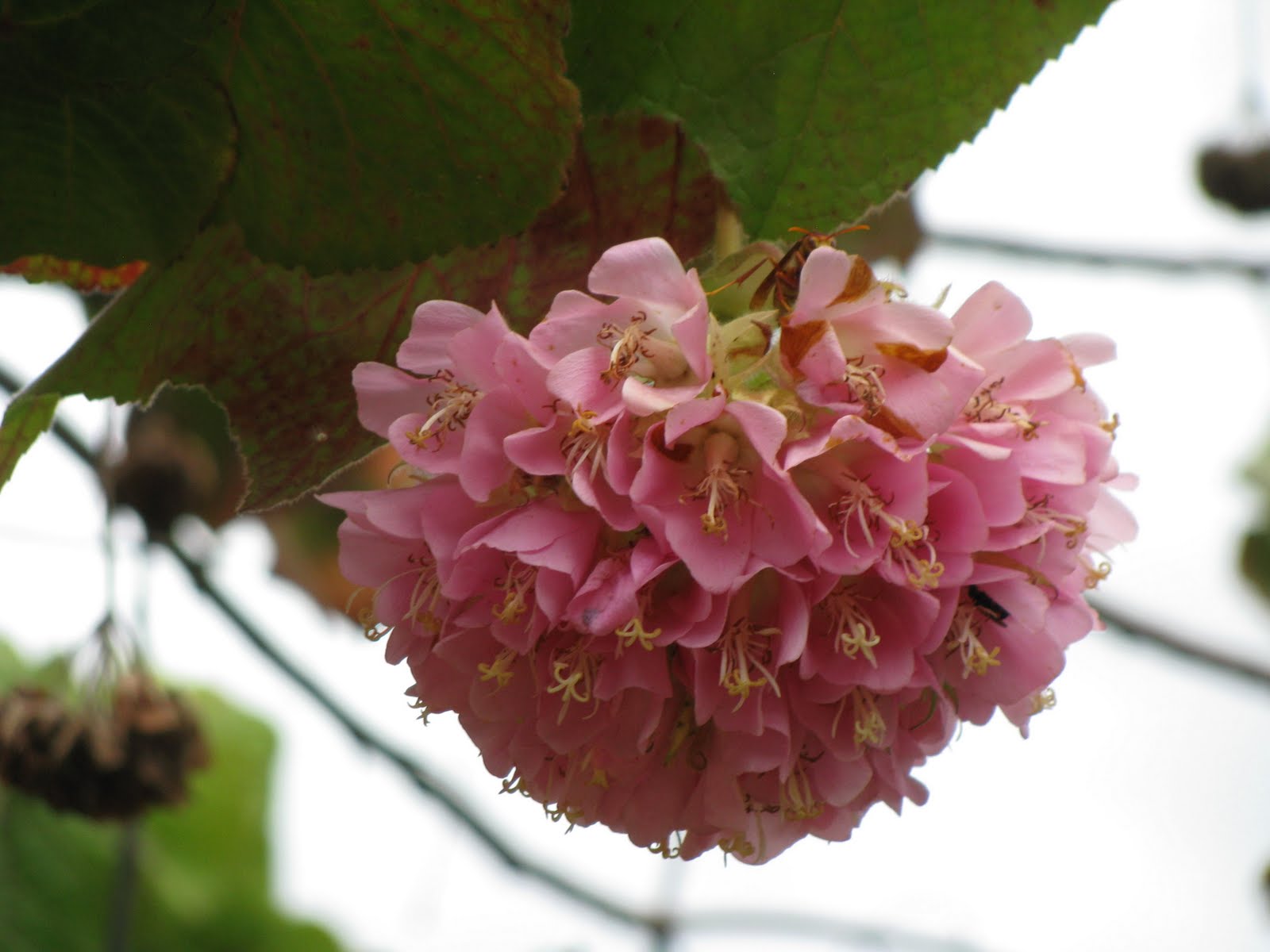
This is one of the flowering bushes I have on my farm
I love flowers and plants, a trait I learned from my mother
I have planted hundreds of fruit trees at the farm and I have always wanted to have a fish pond and organic vegetables. Is it possible that this might happen? The guys seem to think that it is a great idea.

My younger brother wants to help me with wind power to power the water pumps and to make electricity for the farm house. Solar heat to run an oven. What more can a girl ask for? Flowers, fruit trees, organic vegetables, animals, a place so quiet I can hear God speaking... After all heaven is closer at 5,200 feet above sea level.

I think I will start building on the missions house again... I am revived and excited listening to the young men who shared my world with me yesterday. It was a meeting meant to be, planned by God, who started putting together the pieces many years ago!

The book on my life is coming along. You might like to read Chapter One. It is still in the editing stages and Moncho and Luz no longer work at the farm and Papi has died... but it will give you an idea of life at the farm.
Chapter One
I walked out the front door of the house into the beautiful ambience of my rooster’s crowing in the foreground, the neighbor’s rooster crowing in the background, natural parrots singing both close and in the distance. Last night’s rumbling sound of every frog in the vicinity croaking in unity, ecstatic about the third rain of the Honduran rainy season, was a thing of the past. Now only two frogs were croaking at each other, one close and one responding in the distance. Sometimes I have the blessing of a short visit from a pair of quetzals[1] from La Tigre the natural cloud forest on the next mountain over.
This morning the view was not different than most, the Valle de Cantaranas (Valley of the Singing Frogs) below me was invisible, full of white clouds. The mountains on the north side of the valley looked blue and Monet soft in the morning light, the tips standing far above the puffy clouds below. The sun not yet visible in the east as I looked at the tops of the mountains situated to the east of my small Honduran farm. The points of La Torre[2] were clearly visible as were the four peaks to the right and the one to the left. Below the peaks, eye level to where I was sitting the white clouds began. “La Torre” is less than two miles away and houses the old Hondu-Tel tower and the almost new Cel-Tel tower.
Cel-Tel the Honduran version of cellular telephone was my only communication to the outside world. Five years ago, in April, I paid Hondu-Tel over two hundred dollars for the installation of three telephone lines which to date have not been installed, but only because I have an aversion to paying bribes. Honduras tel who want to sell these extra lines to the highest bidder, all under the table of course. The problem is, I need the telephone, the dilemma, I have an aversion to paying bribes! There is stubbornness and hate in me about injustice. This whole situation smacks of injustice.
As I was sitting, looking at the gorgeous view, my mind began to wander as I thought of how strange it was that things are not always as calm as they may appear. Here I was sitting in this peaceful atmosphere and yet my real peace came from somewhere other than the incredibly stunning ambiance that was surrounding me. How did I ever get to the place in my life where I had that kind of astoundingly deep inner peace?
I remember thinking to myself about when I first journeyed to Honduras
Electrical engineer, Don Rafael C. [4] owns the farm next door to the west. Less than one hundred feet from my back patio sits the adobe house of Don Mario, Don Rafael’s mayordomo[5]. The old zinc roof corroded to a rusty red is topped by orange clay tiles haphazardly placed along the top of the eighteen-foot roofline. In certain locations red bricks hold down the edges of the zinc lifted by former winds and now too decomposed to nail back into place. The roof is attached to hand cut wooden strips sagging with age and the weight of the branches of a tree full of mandarin oranges, growing too close to the house and never trimmed. One can only wonder if a seed fell close to the house and the tree sprouted and grew on it’s own volition, a seed spit on the ground and never eaten by a wild bird, or if as many other things in Honduras, the tree was actually planted with no forethought to the consequences in a few short years.
The adobe home, once painted white with cal [6] long since wearing off so that the house now looks like an odd white and clay orange irregularly shaped polka dot edifice. The face of the house sports five extra long fence posts with zinc protruding from the roof sitting on top of them to form a corridor along the front of the house about four feet wide. The corridor floor and the inside floor of the house, hard packed dirt, hard like cement from years of use. The adobe [7] residence actually about twelve feet by seventeen feet with two front doors and a back door is home to Don Mario and his extensive family.
This morning Santos Reyes Salgado Cerrato [8] better known as “Papi” has arrived to work in the garden. As I look at Papi, I see an old, old man, face and skin worn by years of hard labor, exposed to the Honduran sun. Today Papi has on Fila tennis shoes with iridescent patches on the back of them, navy mostly fuzzy Izod Lacoste socks, complete with the little alligator; his extremely worn dress slacks tucked inside his socks forming Papi’s version of a bowyang. [9]
Papi, extremely thin, has on navy blue dress pants; darts sewn in by hand with a needle and white thread cinch up the waistband of pants that are entirely too large for him, but great to work in. The belt loops on his pants long ago gone except for two, one hanging on by a thread. A small piece of cord tied around his waist and through the existing loops as if he imagines that this small white cord will hold his saggy pants up.
Cayenne pepper sprinkles the back of his pants and the sleeves of his well-worn patched and re-patched, faded navy blue, former mechanics jacket, hole in the sleeve on the right, as he gingerly leans over the bright orange poppies, multi-colored iris, amaryllis and lilies, sprinkling orange red cayenne pepper where the ants have begun eating. Under Papi’s well worn jacket he sports a pinstripe shirt, most likely from the closet of a preppy young American student, long ago donated to some non-profit organization, shipped on a container, maybe by boat to Honduras and latter given to the poor. Papi qualifies as poor so far as money is concerned, but this septuagenarian is rich in spirit. Every ten or fifteen minutes Papi leans against a post with his head down and prays for whatever comes to mind at the moment. Sometimes he lifts his face to the sky, tilting back his straw hat full of holes and creases and says, “Gracias Señor”.[10]
Papi, when he was young, was a fool. He had a wife and children but he also had girlfriends and he drank like a fish. Today, very repentant, he wishes he had not wasted so many years. Once strong and extremely good looking, Papi walks favoring his right leg, slowly but surely he walks the four kilometers up steep hills to his job at my farm. Papi is in love with God. Every time he plants a seed he says a prayer. He never learned to read and write, but knows many scriptures by heart. On this last trip has asked me to buy him a cassette player where he can listen to Christian music and teaching.
I inherited Papi. I inherited him like a new owner of an old house inherits old wallpaper and old curtains, off color, faded, not exactly what I would have picked for myself, but he was there, convenient, and now I wouldn’t trade Papi for all of the tea in China. He is sweet, kind and gentle, he shares my seeds and plant cuttings with others and he shares with me things from his garden. He prays for me every day and greets me with his toothless smile and a much wrinkled face whenever I arrive in Honduras
When I bought the first piece of land it was the side of a mountain with a steep gully and another mountainside. There were three adobe houses, a pigpen and virtually nothing else except for an amazing, breathtaking view. My husband, Mike, thought I was half-crazy, but he knew because of my insistence that I saw something for the future of this piece of land. My plan of action included hiring a DC9 tractor to level off the top of two of the mountains and fill in the gully with the removed dirt in order to make a smoother landscape and to have a clear view of the valley below. The day the tractor arrived and began to move the mountain, the dirt road above filled with neighbors. For a full week none of my neighbors worked and everyone watched as the mountains came down and the tops leveled off as the gully filled up. What was a double black diamond ski run in case of a good Colorado
Twenty-five foot high stonewall terraces have been constructed close to the road, to hold the road in place, thereby disallowing the mountainside of red clay to collapse onto the buildings situated below. These man-made terraces also provide flat places for the two hundred fruit trees that I have purchased, traded for, grown from seed, and/or received as gifts. Papi has planted, nurtured, and loved them into viable, ready to produce and producing trees.
At last count there are over two hundred banana trees of four varietals on the farm. Every year this number increases by four or five times. Each banana tree grows baby banana trees close to the trunk of the original. I never knew that there were so many types of bananas until I visited the Philippines
My pride possessions on the farm are the marañon trees. I bought the fruit on the side of the road in southern Honduras United States
When I began work on my place of refuge, a place to go to read my Bible, pray and relax, Moncho was working with Don Felix, the always drunken foreman, who at that time was building my small house. Although Don Felix came to me highly recommended, he had various problems, in spite of which he had successfully built the small church, in El Tablon, a suburb of Valle de Angeles. That project, under the watchful eye of Pastor Peter Jurka of Zion Ministries, had turned out nicely. Pastor Peter, a native New Yorker and a missionary to Guatemala and Honduras
Moncho, a strong young man with bulging muscles, not oversized from lifting weights, but flawlessly developed from lifting bags of cement and rocks as he goes about his daily work, became very attached to me one night when he and his wife came running up to the house, a dead limp baby in their arms. What was normally the beautiful porcelain face of the two month old little girl was blue! She was not breathing!
Moncho and Luz Marina, his wife, and their brood of six little ones live in two buildings located on the side of the hill below my little house, but still within my property. Luz is pregnant again, so maybe I should say seven little ones.
The larger of the two buildings is the oldest. It consists of three rooms, constructed of adobe and carefully plastered with cement stucco. The roof is zinc, the orange clay tiles across the top carefully set with cement where they won’t move even with the worst wind. The outside and inside are carefully painted white with real paint, not cal, like the neighbor’s and washed down with water from the spring on a regular basis. The semi-wide corridor outside provides a resting place for a few lawn chairs and the five adult black and tan Dobermans with unclipped ears, but docked tails, that live on the property. The building is divided into three rooms, a salon area, and two bedrooms. Moncho, Luce and the two girls sleep in one room while the four boys sleep in the other. They have a hand made crib in place, next to their bed, covered with a soft mosquito net, for whoever is the latest addition to the seemingly ever-growing family.
The smaller building, almost attached, but with a seven-foot distance between them, contains the kitchen, bathroom and pila. This building is twenty five feet long and divided by a long metal pole with multiple, multi-colored shower curtains hung so that there is about a six inch gap between them and the floor. Behind these curtains are two ceiling high closets with screen wire doors, a stool, a sink and a shower stall, made from off white and green tile, carefully handcrafted by Moncho. On the kitchen side of the curtains, but close to the front door, is a small three-foot tall refrigerator cautiously placed on eight cement blocks, in order to make it higher for easier access, for Luz and harder access for all the inquisitive little hands in the house. This dorm size refrigerator holds all the cold food for this steadily growing family of eight.
Across from the refrigerator is the pila. A pila is a cement and block, handcrafted furnishing found in every Honduran house. No house is a home with out a pila. What is a pila? What isn’t a pila? The pila is waist high or higher and approximately five feet wide, by four feet deep. Water is stored in the tank part of the pila, while part of the tank is covered with a smooth top with a drain and the other side is covered with a wavy rubbing-board top, made from cement but slick from wear, used to scrub clothes. A faucet, like I have attached to the outside of my house in the States, turns on and off to allow the free flow of water from the holding tank one hundred feet up the hill. This tank, also called a pila, in turn is fed free flow by a spring located 2 kilometers up the road. The holding tank inside the pila in Luce’s kitchen holds the water that is then lifted up on top of the pila to wash clothes, dishes or hands with a small plastic rubber bowl, one dip at a time.
The spring that feeds the tank, that feeds the pila, that feeds my house and my kitchen, as well as Luz’s kitchen and bathroom, has an interesting story. When I first bought the property, in 1994, I couldn’t read any Spanish. In fact I couldn’t speak any Spanish either, so I didn’t know that included with my purchase was a parcel, nine tenths of an acre in size, two kilometers further up the road replete with a large natural spring. The previous owner of my land purchased this spring and the land around it, from a man named Adan Pinto. Adan and his live-in-common-law wife of thirty years sold the spring land to Don Marco Tulio where he would have a constant supply of water. For years the spring had provided water and never run dry. That was soon to change.
Situated next to the pila on the right is an oven, no not an electric oven or a gas oven but an oven made out of adobe that looks like half of a huge oversized egg. This ancient style oval shaped oven, heated by wood, is often used as a temporary housing for a gallina culeca [13] that needs to be protected from the five black and tan adult Doberman’s freely running in and out of the kitchen. Situated … next to the oven is a wood stove, bricks covered with stucco on four thirty inch pillars made of bricks and a piece of tin roofing carefully placed to form a platform over the wood as it burns. This is the only way to heat handmade fresh… Etc. making tortillas according to the Honduran locals.
Luz gets up every morning, sends her oldest son Darwin on a walk to have partially dried corn ground into meal with which to make the fresh tortillas. When Darwin
To help protect everyone, people and animals, I maintain an aliquot [14] number of geese on the farm. Geese are very interesting, when they choose a mate they are with that mate for all their life. Geese are most satisfied when they are in pairs. It is sad to observe the odd goose out, when they are not evenly divided, male and female. Satisfied geese are like watchdogs. They make a loud noise in unison to warn everyone around when there is an intruder.
It was a dark night when that intruder named Death that made a visit to my farm to steal the life of Moncho and Luz’s baby girl. It was that very night that Moncho and Luz began to accept me as part of their family. That night the geese made no noise as this unwanted intruder snuck onto the farm neither did the Doberman’s bark. When Moncho and his wife came running up to the house, a dead limp baby in their arms, they were in a panic, as any parent would be, their two month old beautiful porcelain doll was blue! She was not breathing! I heard banging on the door and rushed to see what the crisis was. To my dismay I saw a baby blue and hanging from her father’s arms, limp like a rag doll. I immediately grabbed the baby and began praying; I threw her on the top of my bed and instantly began to intercede for her calling on the name of Jesus and at the same time checking her for any signs of life. I pressed on her little chest and she drew a deep breath and then whimpered. Life had returned and that cruel visitor Death had been sent away, not by the sound of geese, nor by the five ferocious Dobermans, but by the heart cry of a believer praying and then heard and answered by a loving Heavenly Father.
[1] Quetzals are the Guatemalan national bird they are lime green in color and the males have tail feathers up to twenty five feet long
[3] Amebas are a bacteria which causes Montezuma’s revenge
[4] Don: a Spanish word used like you would use Mr. in English, a respectful way to address someone.
[6] Cal
[7] Adobe is a block type construction, the blocks made from a red indigenous clay
[8] Honduran names are first name, middle name, last name and mother’s maiden name: in that order
[9] Boeyang:['bo-yæng] A piece of leather or cord tied around the trouser leg, just below the knee to prevent, according to legend, snakes from crawling up the pants' leg. More likely, they originally kept the trousers from riding over the knee and binding when miners, shearers, and the like, bent over to work.
[10] Thank you God
[11] Cucumbers
[12] a cousin that is like a brother, maybe even raised in the same home
[13] Gallina culeca – Honduran (Colloquial) Spanish for “sitting hen”
[14] Aliquot - an even number, can be divided by 2


 Posts
Posts


